The problem
Evaluating a single Indian stock means juggling charting tools, screeners, annual reports, and news feeds — then holding the thesis together in a spreadsheet. Across a full portfolio, the process breaks down: decisions drift with emotion, risk limits live in someone’s head, and six months later nobody can say why a position was entered. In Indian equity markets, with fragmented local data sources and market-specific trading rules, the problem is worse.
The solution
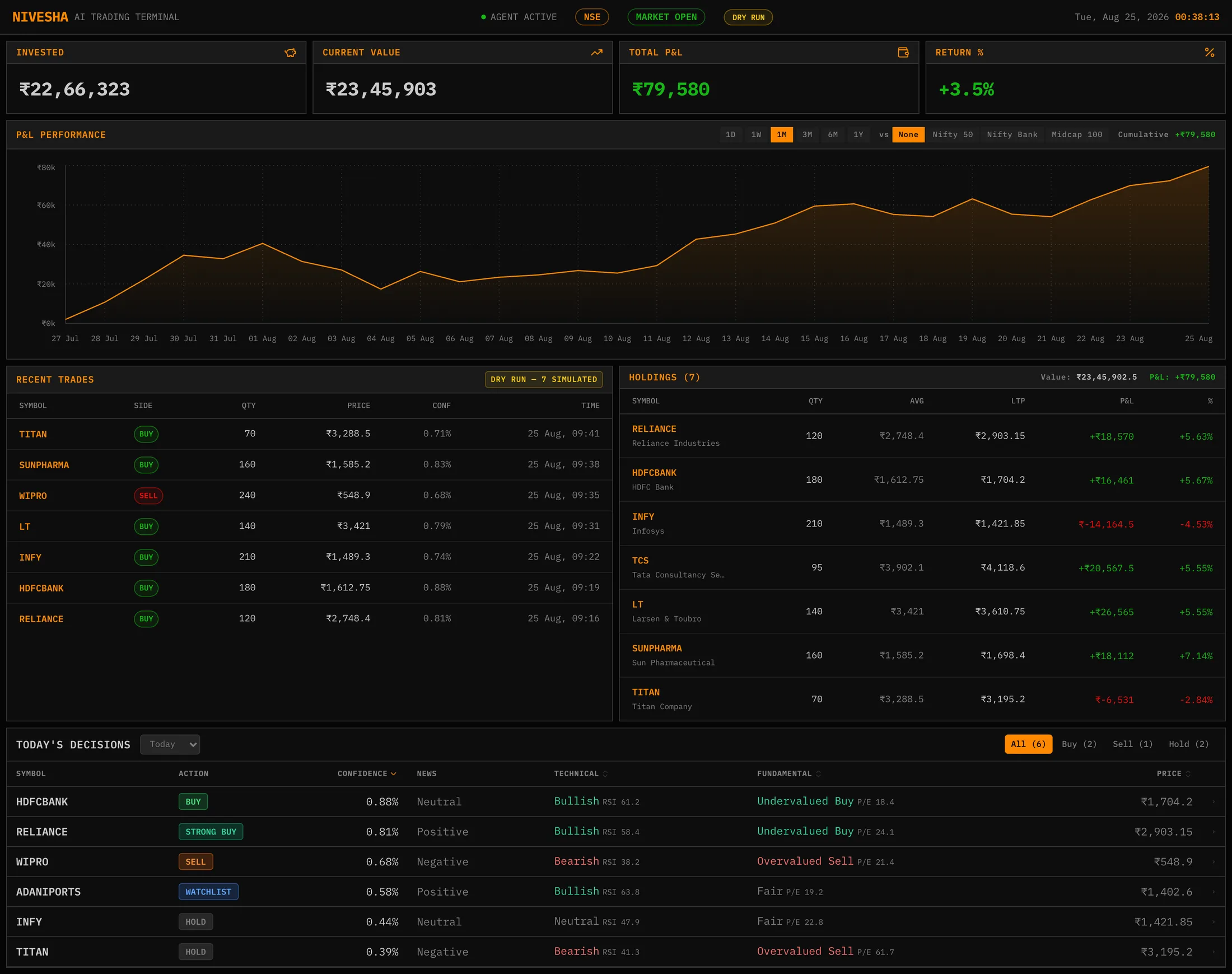
Nivesha holds a continuous, evidence-backed view on every stock in the Nifty 500 — weighing price action, company fundamentals, intrinsic value, and market sentiment together instead of one screen at a time. Risk limits are enforced by the platform rather than left to discipline: position sizes, sector concentration, stop-losses, and circuit breakers apply before a trade goes through, not after a review.
Nivesha is our own product — built end to end by Minus, using the same four-phase process we run for clients. It’s what our engineering looks like when we are the client.
Results
- Every Nifty 500 stock evaluated continuously — no manual screening
- Every recommendation traceable — the decision log answers “why did we buy?”
- Risk limits enforced by the system — position, sector, and stop-loss constraints
- Strategies proven before money moves — backtesting with Sharpe ratio, drawdown, and benchmark comparison
Under the hood
Signal reconciliation · Risk engine · PostgreSQL decision log · Backtesting
Technical, fundamental, valuation, and sentiment reads are produced independently and then reconciled into one position decision, so no single signal can carry a trade on its own. Every decision is written to a PostgreSQL log alongside the inputs that produced it — which is what makes the reasoning auditable months later. Strategies are backtested against benchmarks before capital is committed.